Rock Bottom
The deepest point on Earth is home to crustaceans in aluminium armour and very busy microbes, and they could help us look for life on icy moons.
This week I was playing Krillion, a daily trivia game where every rare answer takes you deeper into the ocean, and a really good round gets you thousands of metres down. It got me wondering what is actually down there. How deep do krill really go, and what lives at the very bottom? The answer turned out to be a rabbit hole about the lowest point on Earth, crustaceans that make their own metal armour, and why all of this matters to people looking for aliens.
The lowest point on Earth
On land, the lowest point is the shore of the Dead Sea, about 430 metres below sea level, and it keeps getting lower as the sea shrinks. But the real bottom of the planet is underwater. It is the Challenger Deep, at the southern end of the Mariana Trench in the western Pacific, and the most careful recent estimate puts it at about 10,935 metres deep. Other surveys give numbers up to around 11,000, because measuring the depth of something that far away through moving water is genuinely hard.
To picture it, if you dropped Mount Everest into the Challenger Deep, its peak would still be about two kilometres underwater. The pressure at the bottom is more than a thousand times what we feel at the surface. There is no sunlight, the water is just above freezing, and food arrives only as a slow drizzle of dead things sinking from above.
The people who have been down
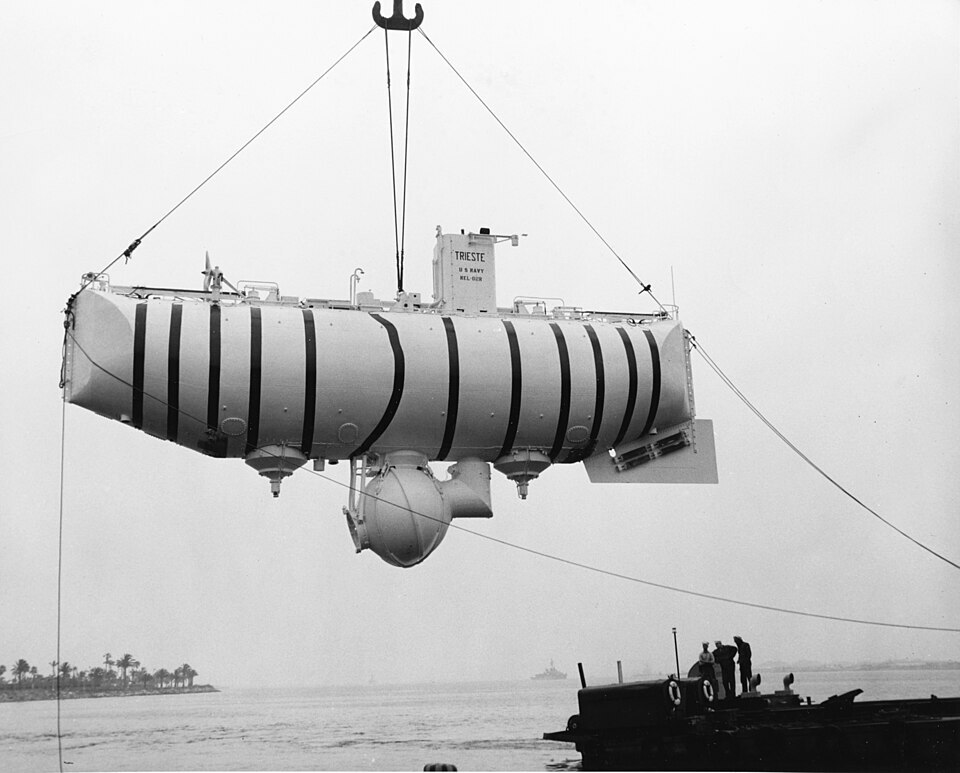

The trench is named after HMS (Her Majesty’s Ship) Challenger, a British survey ship that measured its depth with a weighted rope in 1875 and got 8,183 metres, which was already astonishing. In 1960, Jacques Piccard and Don Walsh sank to the bottom in the Trieste, a submersible that was basically a giant float full of petrol with a tiny steel sphere for the two of them underneath. Nobody went back for 52 years, until the film director James Cameron made a solo dive in 2012.
My favourite visitor is Kathy Sullivan. In 1984, she became the first American woman to walk in space. In June 2020, she dove to the Challenger Deep with the explorer Victor Vescovo, becoming the first woman to reach it and the first person ever to have been to both space and the deepest point of the ocean.
So, do krill go that deep?
Not quite, but deeper than anyone expected. Antarctic krill were always thought to live near the surface, until a team from the British Antarctic Survey filmed adult krill feeding on the seafloor about 3,000 metres down in 2008, scooping up plankton that had sunk to the bottom. Some of them were pregnant females.
At the very bottom of the trenches, the krill’s place is taken by their crustacean cousins, the amphipods. Baited traps lowered into the Challenger Deep come back swarming with them, and the star is Hirondellea gigas. It is only a few centimetres long and lives at almost 11,000 metres.
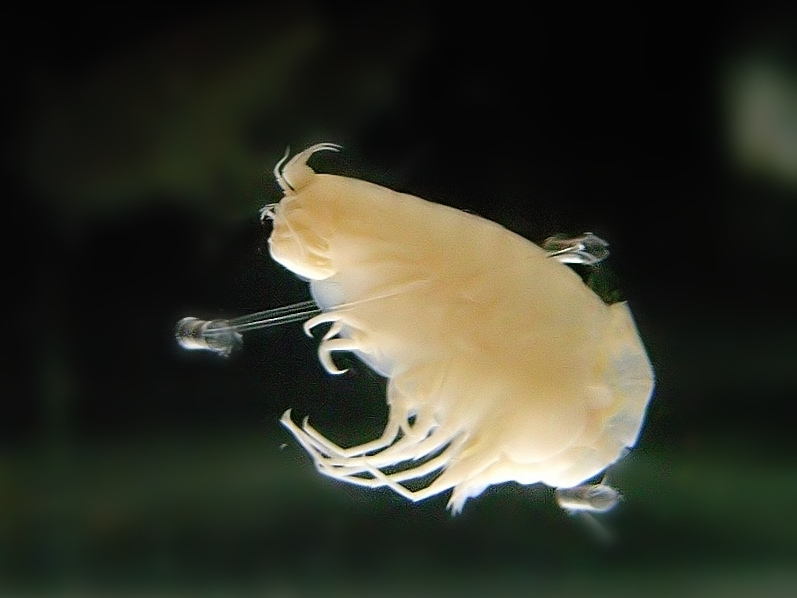

Here is the part that blew my mind. Like most crustaceans, its shell contains calcium carbonate, which should dissolve at that depth and pressure. In 2019, Japanese scientists found that H. gigas protects its shell with aluminium. It produces a chemical in its gut that pulls aluminium out of the mud it eats, and in alkaline seawater that aluminium turns into a gel that coats its body like a shield. A tiny animal, in total darkness, making its own metal armour.
The deepest fish
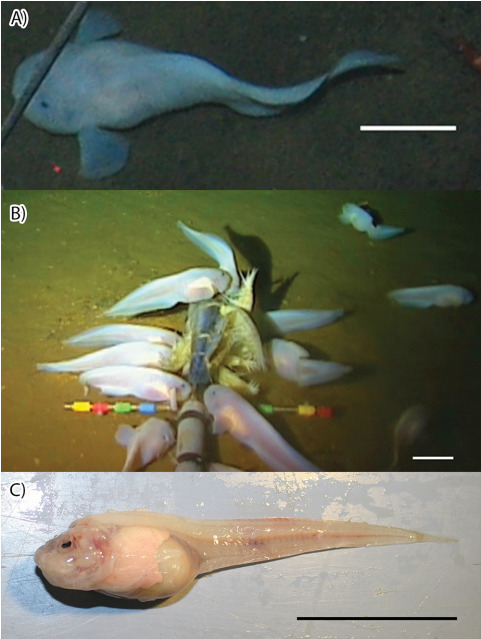

Fish do not make it all the way down. The deepest fish ever filmed is a small juvenile snailfish, recorded at 8,336 metres in a trench south of Japan in 2022. Snailfish look like pale, jelly-like tadpoles, which turns out to be an advantage, since they don’t have a swim bladder full of air that would be crushed. Biologists think fish hit a hard limit at around 8,400 metres. Below that, the molecules fish use to protect their cells from pressure would make the inside of their bodies more concentrated than the seawater around them, and water would start flooding into their cells.
The busiest mud on Earth
You might expect the bottom of the trench to be nearly dead. In 2013, a team dropped a robotic lander into the Challenger Deep to measure how much oxygen the mud was using, a sign of how busy its microbes are. The microbes there were about twice as active as those at a nearby site 6,000 metres deep. The reason is shape. The trench acts like a funnel, collecting sinking food from the slopes all around it, so the mud at the very bottom gets more to eat than the seafloor nearby.
Many of these microbes are piezophiles, which means “pressure lovers”. They don’t just survive extreme pressure, they grow best under it, and some of them struggle to grow at all at the surface.
What this has to do with aliens
This is where it connects to space. Some of the best places to look for life in our solar system are not planets but moons. Jupiter’s moon Europa and Saturn’s moon Enceladus are both covered in ice, with whole oceans of liquid water hidden underneath. Those oceans are dark, cold and under enormous pressure, a lot like the bottom of the Mariana Trench.
Enceladus even sprays its ocean into space through cracks near its south pole. When the Cassini spacecraft flew through those plumes, it found hydrogen, a possible energy source for microbes like the ones living around deep-sea vents on Earth. In 2023, scientists also found phosphates, one of the essential ingredients for life, at concentrations at least a hundred times higher than in Earth’s oceans. NASA’s Europa Clipper launched in 2024 and arrives at Jupiter in 2030 to take a closer look at Europa.
The trenches teach us three things here. First, that life does not need sunlight, warmth or low pressure, which makes these icy oceans much more promising than they once seemed. Second, they show us what to look for, since deep-sea life can do things we would never have guessed, like building aluminium armour. And third, they tell us that if we ever want to find life on another world, the best place to look might not be the surface at all, but the dark mud at the very bottom.
Not bad for a rabbit hole that started with a trivia game.