Energy Saving Time
Why is Egypt the only country in Africa that changes its clocks? It has nothing to do with daylight.
I missed more meetings than I would like to admit last week. Europe turned its clocks back on October 25, but the US only did it on November 1, so for one whole week every transatlantic meeting was an hour off from where my brain thought it was. While I was busy apologising to collaborators, I started wondering which countries even bother with daylight saving time, and I found out something strange. Egypt is the only country in Africa that does it.
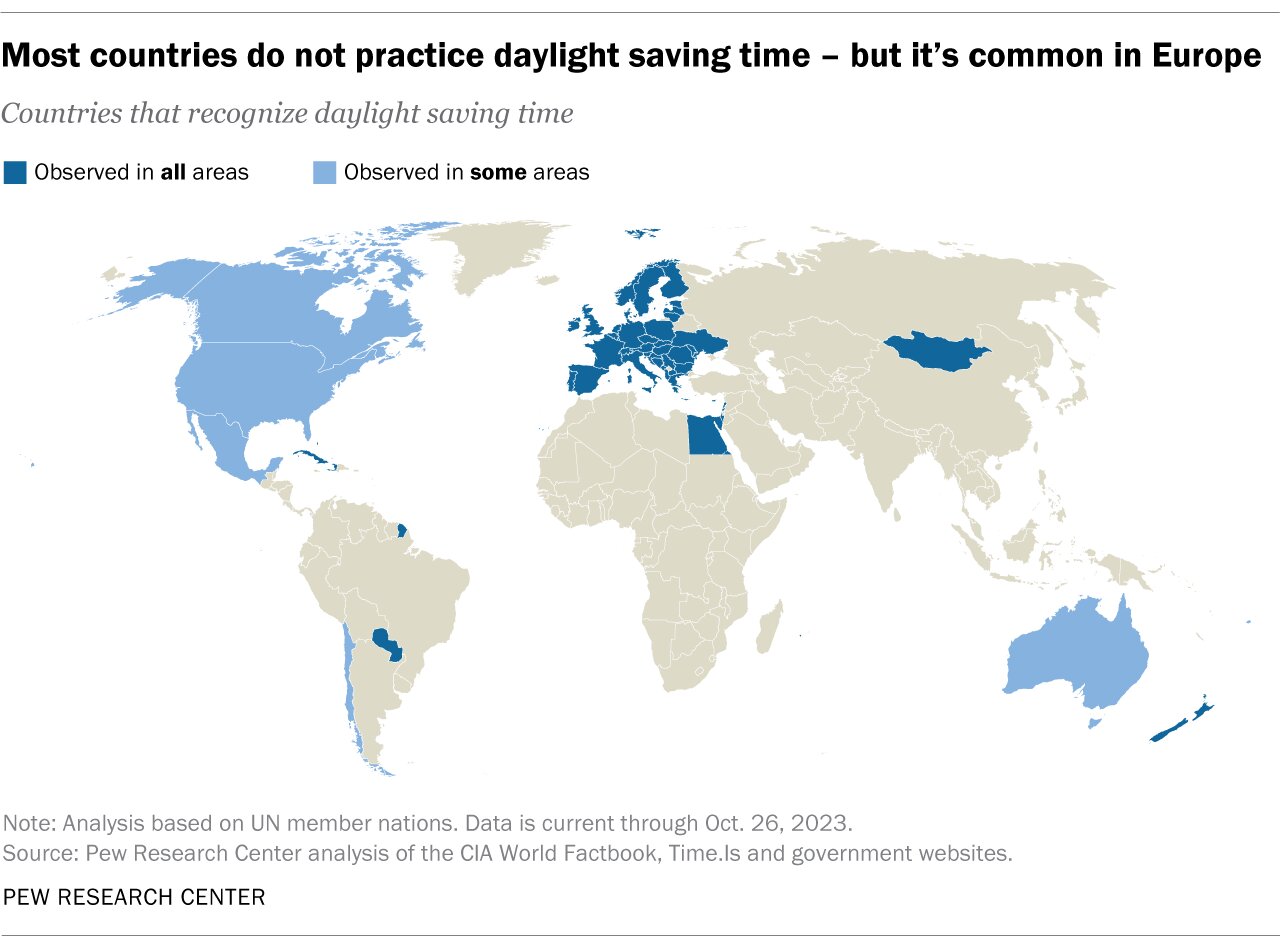
Why would Egypt need to save daylight?
At first this sounds completely unnecessary. Daylight saving time exists because places far from the equator have very long summer days and very short winter ones, so shifting the clock moves some of that extra summer light into the evening. Egypt has plenty of light all year round. And why would it be the only one in all of Africa?
The geography backs up my confusion. Look at how much the length of the day changes over a year in three cities.
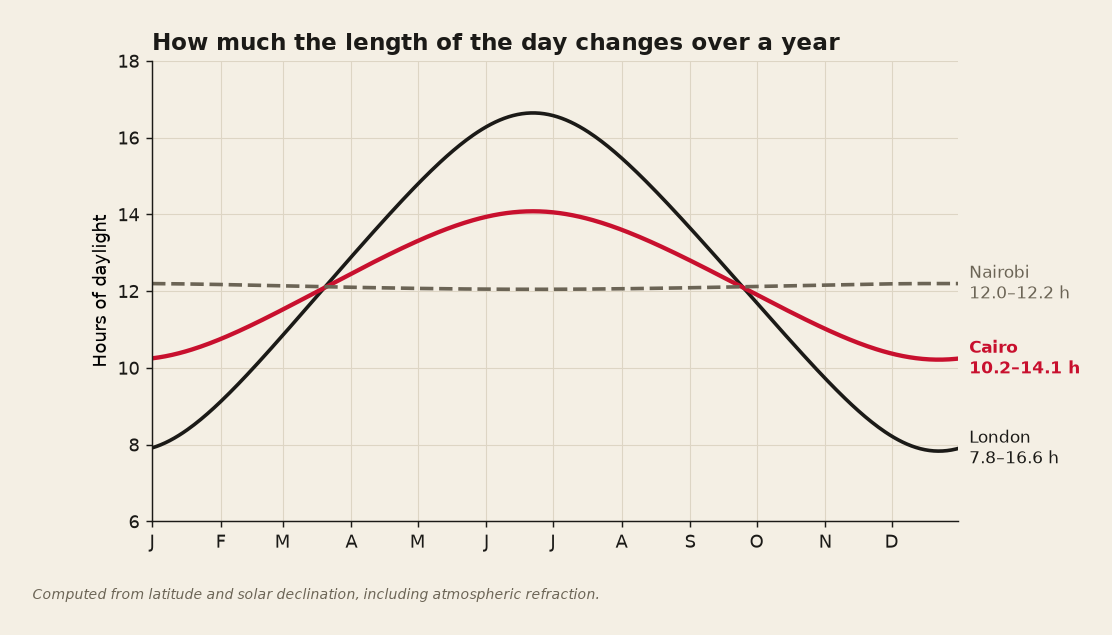
London gets less than 8 hours of daylight in December and more than 16 in June, so moving an hour of light around actually makes a difference there. Cairo only swings between about 10 and 14 hours, and near the equator in Nairobi, the day is basically 12 hours long all year. Most of Africa sits close to the equator, which is why almost nobody there bothers. The countries outside Europe and North America that still change their clocks, like Chile, New Zealand, southern Australia and Israel, all sit further from the equator, and Egypt sits right at the edge of where it starts to make sense.
There is always a colonial connection
My next thought was that the British ruled Egypt, so maybe there was a connection. And there was. The British first introduced summer time in Egypt in 1940, during the Second World War, when Egypt was a key British military base. It stopped after the war, came back in 1957, and then Egypt spent the next several decades switching it on and off.
After the 2011 revolution, the transitional government abolished it. It came back in 2014, was cancelled again in 2015 after the electricity ministry said the savings were not of “any tangible effect”, and in 2016 the government famously cancelled it just three days before the clocks were supposed to change. Then, in 2023, it came back again.
Energy Saving Time
Here is the twist. Egypt does not use daylight saving time to save daylight at all. It should honestly be called energy saving time. When the government restored it in 2023, the stated reason was to save energy at a time when fuel had become expensive after Russia’s invasion of Ukraine. The less natural gas Egypt burns in its own power plants, the more it can sell to Europe for much-needed foreign currency. Egypt had exported around $600 million of gas to Europe the year before and was hoping to reach $1 billion, and the electricity ministry estimated the clock change would save about $25 million worth of gas.
This doesn’t completely make sense to me though, because the heat is the same no matter what the clock says. In a hot country, the biggest demand on the power grid is not lights, it’s air conditioning. Shifting the clock means people are home and awake during the hottest part of the evening, possibly running their air conditioners even more. And there is research suggesting exactly that. When parts of Indiana adopted daylight saving time, economists used it as a natural experiment and found that it actually increased household electricity use by about 1%, mostly because the savings on lighting were wiped out by extra heating and cooling. Egypt’s own electricity ministry reached a similar conclusion back in 2015, which might explain why the country keeps switching it on and off.
So why only Egypt?
Put it all together and Egypt is an odd mix. It sits just far enough from the equator for daylight saving time to be possible, it inherited the habit from the British during the war, and today it keeps it mostly as an economic bet on exporting gas rather than anything to do with sunlight. Morocco, the other North African country with complicated clocks, used to permanently run an hour ahead and briefly switch back during Ramadan, but it returned to plain GMT this September, leaving Egypt truly alone.
As for me, I have now put every collaborator’s time zone into my calendar, so hopefully next spring goes better than this autumn did.