Bent but Never Broken
Italy and Ethiopia signed two versions of the same treaty. They disagreed on what it let Italy do.
By 1914, almost every part of Africa was ruled by a European country. Britain, France, Germany, Belgium, Portugal, Spain and Italy had divided the continent between them in what is now called the Scramble for Africa. Only two countries were left standing on their own. One was Liberia, whose name comes from the Latin word for free, although that freedom was a complicated one. It was founded in 1822 as a settlement for freed Black Americans, and for more than a century those settlers and their descendants ruled over the people who already lived there, who did not even get citizenship until 1904. The other was Ethiopia, which did not just avoid being colonised but beat a European army on the battlefield to stay free.
Back then, most of the world did not call it Ethiopia at all. Europeans called it Abyssinia, a name that comes from Habash, an ancient name for the people of the northern highlands, which still survives in the word Habesha. Ethiopians themselves had been calling their kingdom Ethiopia since the fourth century, borrowing an old Greek name, Aithiopia, often explained as meaning “burnt faces”.
A treaty with two meanings
The story starts with a translation problem. In 1889, Emperor Menelik II of Ethiopia signed a friendship treaty with Italy, which had already taken the coast of neighbouring Eritrea. It was called the Treaty of Wuchale, and it was written in two languages, Amharic and Italian.
The trouble was Article 17. In the Amharic version, the one Menelik read, Ethiopia could use Italy to handle its dealings with other countries if it wanted to. In the Italian version, Ethiopia had to. That one word turned a friendly offer into a claim that Ethiopia was an Italian protectorate, and a few months later Italy told the governments of Europe exactly that, asking them to deal with Ethiopia only through Rome. Most of them went along with it, although Russia and the Ottoman Empire refused. When Menelik found out what his treaty supposedly said, he rejected it, and Italy decided to take Ethiopia by force.
Adwa
On 1 March 1896, the two armies met near the town of Adwa in northern Ethiopia. Italy had around 15,000 to 18,000 soldiers. Ethiopia had somewhere between 73,000 and more than 100,000, led by Menelik and his wife, Empress Taytu Betul. Crucially, most of the Ethiopian soldiers carried modern rifles that Menelik had spent years buying from France and Russia, while the Italians were stuck with outdated rifles and artillery because their budget had been cut.
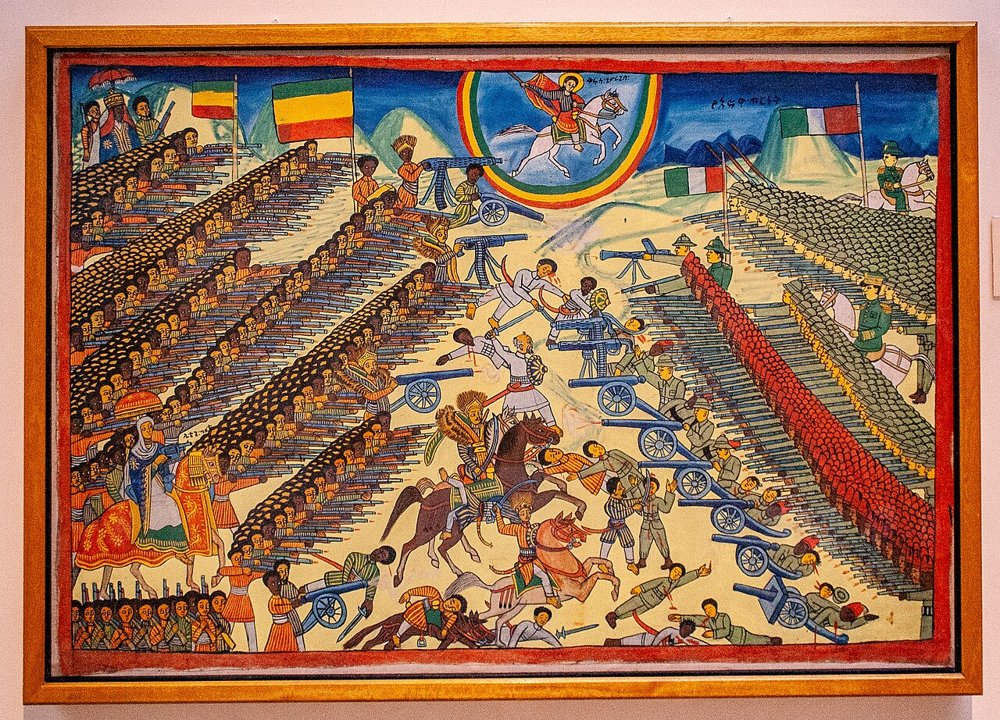

It was a disaster for Italy. More than 6,000 Italian soldiers were killed and nearly 4,000 captured, and the survivors fled, leaving behind all of their artillery and about 11,000 rifles. Back in Rome, people protested in the streets and the prime minister resigned within days. Later that year, Italy signed the Treaty of Addis Ababa, recognising Ethiopia as a fully independent country. Ethiopia became the only African country of that era to keep its independence by winning a war against a European power.
How Ethiopia prepared for war

Ethiopia went into the Scramble for Africa with things most of the continent did not have. It was an old, centralised kingdom with an emperor who could raise a huge army from across the country, and its rugged highlands made any invasion slow and hard to supply. Menelik also understood the European game better than the Europeans expected. He bought weapons from rival powers, played them against each other, and refused to let a single treaty decide his country’s fate.
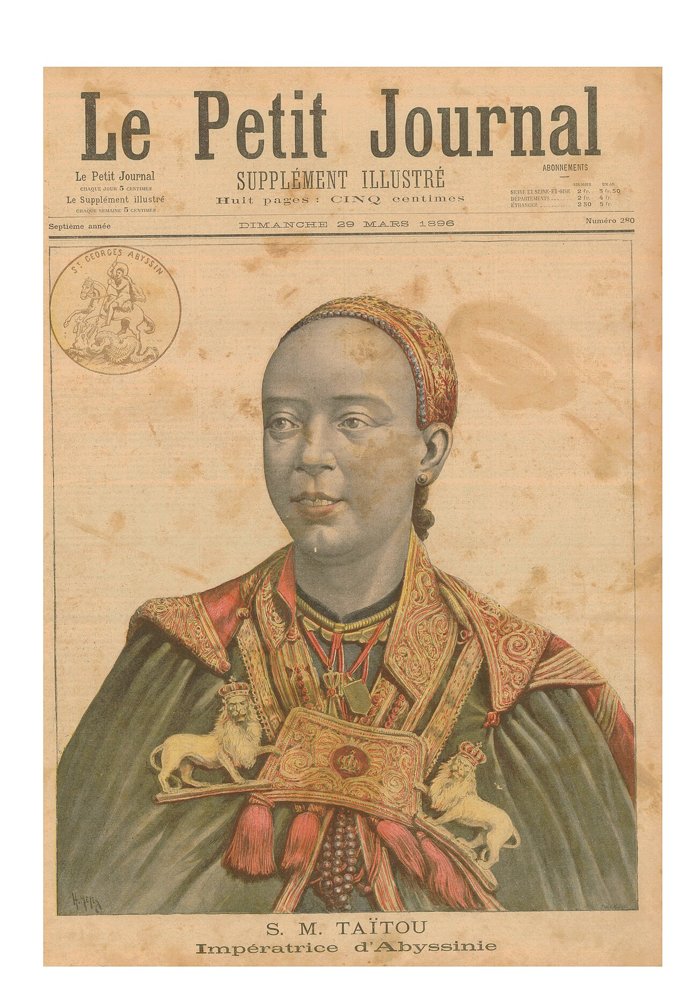
Empress Taytu is a big part of that story too. She was one of Menelik’s closest advisers, fiercely opposed to giving Italy any ground, and she commanded troops of her own at Adwa. A month after the battle, she was on the front page of a French newspaper, which says a lot about how much attention the world was suddenly paying.
Italy invades again
Italy did not forget. Forty years later, Benito Mussolini invaded Ethiopia in October 1935, partly to take revenge for Adwa. This time Italy had planes, tanks and poison gas, dropping around 330 tons of mustard gas on soldiers and civilians, which was already banned under international law. The League of Nations, the body meant to keep the peace, put weak sanctions on Italy that left out oil, coal and steel. In May 1936, Italian troops entered the capital, Addis Ababa, and Mussolini announced that Adwa had finally been avenged.
That June, the exiled Emperor Haile Selassie stood in front of the League of Nations in Geneva and asked the world for help. His speech is remembered for one line, “It is us today. It will be you tomorrow.” Within a few years, fascist Italy and Nazi Germany had dragged the rest of Europe into the Second World War, exactly as he warned.
The end of the occupation
The occupation lasted only five years. Ethiopian fighters kept up a guerrilla war the entire time, the League never formally recognised Italy’s conquest, and Ethiopia kept its seat in the assembly under Haile Selassie. In 1941, Ethiopian and British forces drove the Italians out, and on 5 May, exactly five years after Italian troops had marched into Addis Ababa, the emperor returned to his capital. Because the occupation was so short and so fiercely resisted, most Ethiopians and many historians describe it as an occupation, not colonisation.
The colours of a continent
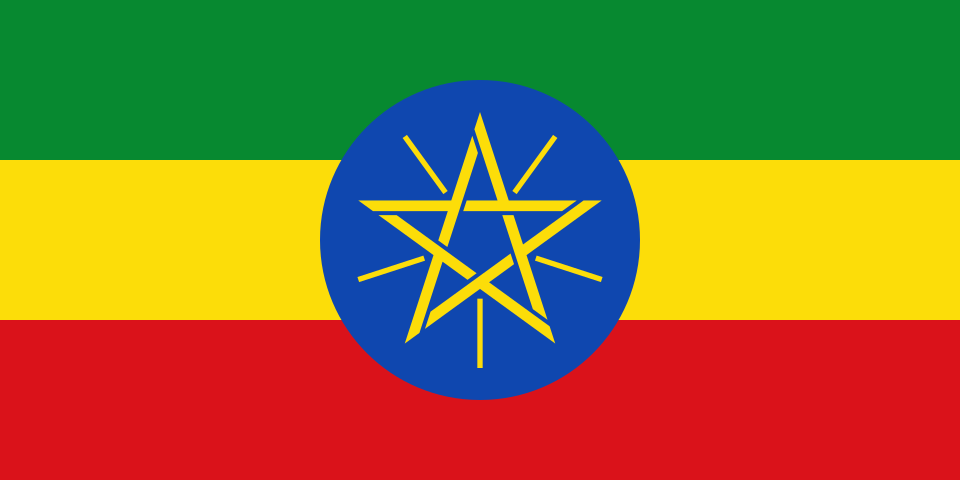

Adwa also gave Ethiopia its flag. In October 1897, a year after the battle, Menelik combined three coloured pennants, green, yellow and red, colours already used by the Ethiopian Orthodox Church, into a single tricolour flag, with the first letter of his name in the middle. Those are the same colours you can see on the flags in the painting of the battle above. The flag has changed since. For most of the twentieth century it carried the crowned Lion of Judah, the symbol of Ethiopia’s royal family, and in 1996 the lion was replaced by a yellow star on a blue disc. According to the government’s description, the star stands for a bright future, its equal rays for the equality of all Ethiopians regardless of ethnicity, religion or sex, and the blue for peace.
What Ethiopia did at Adwa mattered far beyond its own borders. When African countries began winning their independence in the 1950s and 1960s, many of them looked to Ethiopia as proof that Africans could stand up to European powers and win. Ghana became the first to borrow Ethiopia’s green, yellow and red for its flag in 1957, and today 17 countries and territories use those colours or the related Pan-African ones. The African Union has its headquarters in Addis Ababa.