A Seat at the Table
Malthus got the math wrong. The powerful believed him, and the poor paid for it.
So many of these ideas come from the fixed set of trivia games I play online with my friends, and I am loving it. This blog started as a hobby, a way to express myself and let myself enjoy the niche things I like to dive into, and I am really happy with how it is turning out. Recently, one of my friends introduced me to a game called Catfishing. It gives you a list of the Wikipedia links that appear on a page, and you have to guess what the page is about using only those links as clues. It is so random, and I love it.
One of today’s answers was Malthusianism. Most of us have a vague idea of what Malthus proposed, but not of the man himself, or of the avalanche of consequences his idea set off, from changes in law to starvation to eugenics. Michael Shermer, writing in Scientific American, went as far as saying that if he had to list the most consequential ideas in the history of science, good and bad, Malthus would be in the top 10.
The idea
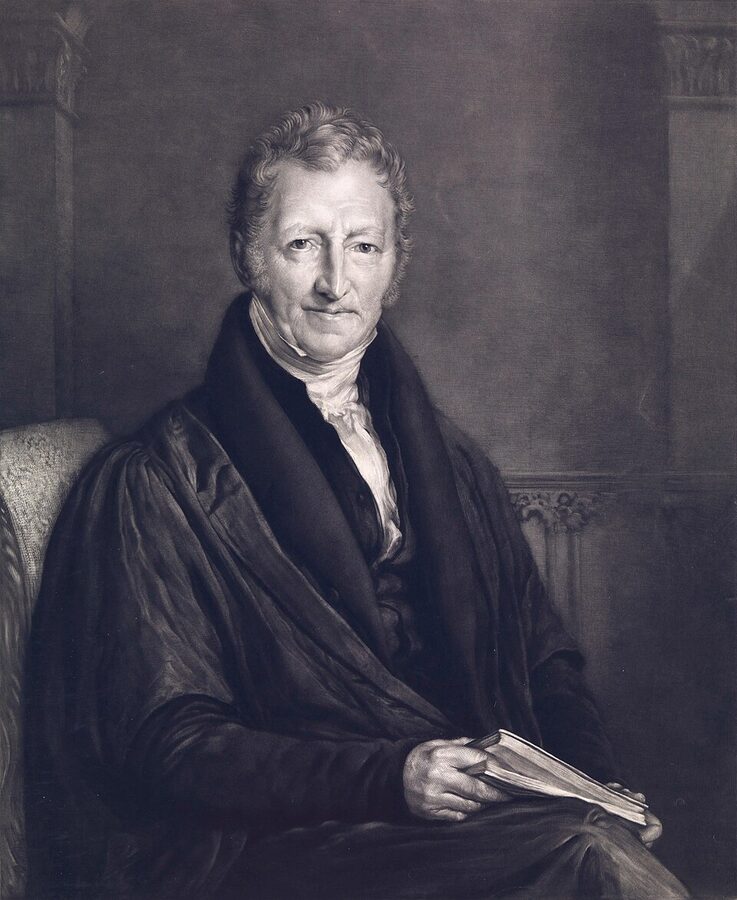

Thomas Robert Malthus was an English economist who also happened to be a clergyman in the Church of England. In his 1798 book An Essay on the Principle of Population, he argued that population, left unchecked, grows exponentially, while food supply only grows linearly. Sooner or later the people outnumber the food, and famine, disease and war step in to bring the numbers back down.
His key number was that a population could double every 25 years, a rate taken mostly from the North American colonies, following an observation by Benjamin Franklin. What I find interesting in itself is that from 1805 until his death, Malthus was a professor at the East India Company’s college, training the young men who would go on to run British India, and yet the Indian colonies never really seem to have entered his thinking.
Remove the excess
I am not writing this article because I was intrigued by the theory. I am writing it because I am disgusted by its consequences. Instead of asking how to produce more food, manage it better or distribute it more fairly, the answer that took hold was to control the population, and especially the poor. My best friend and I always joked about a line from one of our favourite parody videos, “ग़रीब हटाओ, ग़रीबी automatically हट जाएगी” (garib hatao, garibi automatically hat jayegi), which means remove the poor and poverty will disappear on its own. It is a twist on Indira Gandhi’s real 1971 election slogan, “Garibi Hatao”, remove poverty. Reading about Malthusianism, I realised the joke version was basically policy.
England had provided food and support to the poor since the Elizabethan Poor Law of 1601. In 1834, that was overhauled by the Poor Law Amendment Act, shaped by a commission dominated by Malthusian economists, who argued that helping the poor only encouraged them to have more children and drained resources. Relief now meant entering a workhouse, with conditions made deliberately miserable so that fewer people would ask for help. In other words, if you did not prove worthy enough to have a seat at the table, you should not be at it.
A decade later, during the Irish potato famine of the 1840s, the same thinking shaped the response. Charles Trevelyan, the British official in charge of relief, insisted on enforcing the poor law and made the workhouse the only help available to able-bodied men, while food continued to be exported from Ireland. Around a million people died. The more I read, the more horrifying and inhuman it got.
From Malthus to eugenics
Malthus did inspire some genuinely good science. Both Charles Darwin and Alfred Russel Wallace credited his essay with helping them arrive at the theory of natural selection. But that chain did not stop there. Darwin’s cousin, the statistician Francis Galton, took the idea of natural selection and applied it to people, and in 1883 he coined the word “eugenics”, arguing that society should encourage the “fit” to marry and have children.
What shocked me most is who supported it. I had always thought of eugenics as an extremist fringe, but it was enthusiastically taken up by George Bernard Shaw, H.G. Wells and the progressive Fabian socialists, people who were literate, scientific and liberal, and whom we still respect today. In the US, after the Supreme Court allowed forced sterilisation in 1927, around 70,000 Americans were sterilised against their will.
And it hits close to home. During India’s Emergency in 1975 to 1977, a population control drive led by Sanjay Gandhi forcibly sterilised more than 8 million men, around 6 million of them in 1976 alone, with police sometimes surrounding entire villages at night. Remove the poor, and poverty disappears.
Was he wrong?
To be fair, Malthus was not wrong about everything. Economic historians like Gregory Clark argue that his model described most of human history pretty well. Until about 1800, every time food production improved, the population simply grew to eat it, and people did not get any richer. Malthus described the past. His mistake was assuming the future would look the same, right as the Industrial Revolution was starting around him.
Because it did not. Malthus could not have predicted mechanised tractors, chemical fertilisers made through the Haber–Bosch process (which honestly deserves its own article), refrigeration, or the high-yield crop varieties of the Green Revolution, all of which multiplied how much food the world could grow. As the saying goes, necessity is the mother of invention, and as the population grew, so did our ways of feeding it.
Even his modern followers keep losing. In 1968, the biologist Paul Ehrlich predicted mass famines in The Population Bomb, and in 1980 he bet the economist Julian Simon that five metals would get more expensive as the world ran out of resources. Ten years later, all five were cheaper after inflation, and Ehrlich mailed Simon a cheque.
The twist ending
The biggest thing Malthus missed is that people choose to have fewer children as their lives get better. As women gained more rights, education and access to contraception, fertility rates dropped on their own. The global fertility rate fell from 3.3 children per woman in 1990 to about 2.25 today, and in more than half of all countries it is now below the 2.1 needed to keep a population stable. Nobody is having 17 kids like in my grandparents’ generation anymore. The UN now expects the world’s population to peak at around 10.3 billion in the 2080s and then start to shrink.
So after two centuries of worrying that there would be too many of us, many countries are now worried there will be too few. Malthus got the math wrong, but the terrible price was paid because of the people who believed him, the politicians, monarchs and other important people who turned his idea into policy. And as usual, it was the common people who suffered.