The Island That Was Mined Away
Nauru is often called the fattest country in the world. The reason has less to do with willpower than with bird droppings, mining and a century of decisions made by other people.
If you search for the fattest country in the world, one name comes up again and again, Nauru. It is a tiny island in the Pacific Ocean, just 21 square kilometres, home to about 12,000 people, and one of the smallest countries on Earth. Around seven in ten adults there live with obesity, and more than 40% have type 2 diabetes, the highest rate in the world. It is easy to read that and assume something about the people who live there. But the more I read about how Nauru got here, the more it looked like a country that was pushed into it.
An island made of bird droppings
For hundreds of thousands of years, Nauru was a resting place for seabirds. Their droppings, called guano, piled up on the island’s coral rock, and over time rainwater carried the phosphate out of the guano and into the rock below. The result was a plateau in the middle of the island made largely of rock phosphate, some of the purest in the world. Phosphate is one of the main ingredients in fertiliser, which made Nauru’s soil incredibly valuable to anyone trying to grow crops somewhere else.
In 1900, a prospector discovered it. Mining began in 1907, and after the First World War it was run by the British Phosphate Commission, a body set up by Australia, New Zealand and the United Kingdom. For most of the twentieth century, Nauru’s island was dug up, shipped away and spread on farms in other countries, while the people who lived there had little say in it.
Rich for a moment
When Nauru became independent in 1968, it took control of the mining, and the money poured in. In the 1970s and early 1980s, Nauruans were among the richest people in the world per person. The government set up a trust fund to save the phosphate money for the day it would run out. The day did come, and the fund was not ready. Bad investments, including financing a London musical about Leonardo da Vinci that flopped, helped shrink the fund from A$1.3 billion in 1991 to A$138 million by 2002. By the 1990s, the phosphate worth mining was gone.
Nothing left to farm
This is where the obesity story actually begins. Mining stripped away about 80% of the island, leaving the middle of Nauru a field of jagged limestone pinnacles where nothing can grow and nobody can live. Around 90% of the land that could once have been farmed was destroyed. People were squeezed onto a thin strip of land along the coast, and nearly all of their food now has to be shipped in.
Food that survives a long journey to a remote island in the middle of the Pacific is not fresh fruit and vegetables. It is rice, sugar, flour, tinned meat and other processed food. During the boom years, Nauruans could afford plenty of it, and the old diet of fish, coconut and local plants faded away. When the money ran out, the land to go back to farming was already gone. Nauru later sued Australia at the International Court of Justice over the damage, and in 1993 Australia agreed to pay A$107 million, along with yearly payments, while maintaining that it was not responsible for the land mined before 1967.
It is not just Nauru
Here is the part that made me want to rant. Nauru is not even an outlier. Look at the share of adults living with obesity across the Pacific.
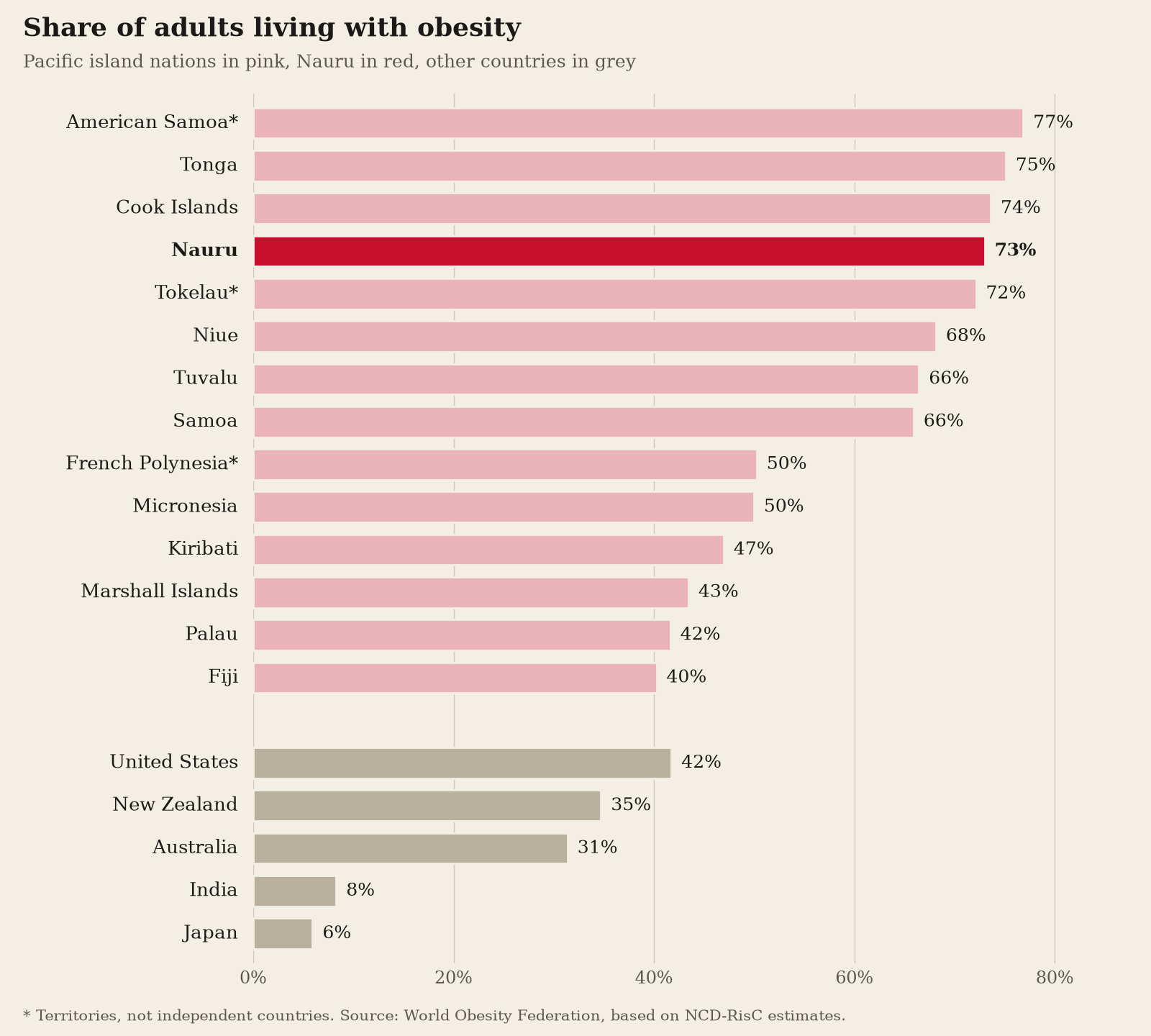
The top eight places in the world all belong to Pacific islands, and in several of them, three out of four adults live with obesity. Many of these islands share Nauru’s problem in a milder form. They are small, remote and depend on imported food, and a lot of what gets shipped to them is the cheapest, fattiest food richer countries do not want.
The best example is turkey tails, the fatty back end of a turkey that Americans rarely eat. Huge amounts were exported to Samoa, so in 2007 Samoa banned them to protect its people’s health. But to join the World Trade Organization, Samoa had to promise to drop the ban, and in 2013 it lifted it. A doctor at Samoa’s own Ministry of Health said it showed the government putting trade ahead of the health of its people.
So is it forced?
Personal choices still exist in Nauru, the same as anywhere. But choices are made from what is available, and Nauru’s options were shaped long before anyone living there today was born. A century of mining that fed other countries’ farms took away the island’s own ability to grow food. The money that was supposed to replace it was lost. What was left was an island that has to import almost everything it eats, at the end of a very long shipping route. Calling Nauru the fattest country in the world makes it sound like a punchline. It is closer to a warning about what happens when a place is treated as something to dig up and ship away.